Dolichothele Uberiformis 5 Seeds Free Shipping!
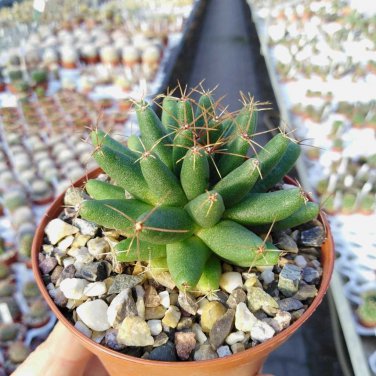
Dolichothele uberiformis is a fascinating succulent that really catches the eye of collectors with its distinct shape. Native to Mexico, it features compact rosettes made up of thick, fleshy leaves. Thanks to its succulent characteristics, it can store water effectively, making it well-suited for dry environments. People often refer to it as the Uberiformis cactus due to its spiny, cactus-like look, but it's actually part of the Dolichothele genus, not a true cactus.
This species of Dolichothele uberiformis boasts a beautiful blue-green color and is adorned with dense, white spines that safeguard its soft tissues. These spines grow uniformly along the edges of the leaves, giving it a unique appearance. Additionally, its slow growth rate adds to its appeal, making it a favorite among succulent fans. The geometric patterns on its leaves showcase its unique evolutionary features, and this Mexican native flourishes in rocky, well-drained soils.
Growing Conditions
Soil: Needs well-drained, rocky soil.
Watering: Water during the growing season (spring and summer) and keep dry in winter.
Light: Prefers light shade to prevent sunburn.
Temperature: Can handle warm conditions but should be shielded from extreme heat.
Thick, fleshy leaves create tight rosettes
Dense white spines line the edges of the leaves
Blue-green color with a slight waxy finish
Compact size makes it ideal for small gardens
Adapted to dry, rocky habitats
The Uberiformis succulent stands out with its sculptural form and tough nature. Collectors appreciate this species for its eye-catching look and manageable size. Its overall shape and structure play a big role in its popularity among succulent enthusiasts around the globe. In short, the Dolichothele uberiformis SEEDS are sure to develop into a stunning and decorative succulent that enhances any plant collection.
Germinating Tiny Seeds
Tiny seeds, almost as fine as dust, such as lithops, other succulents and some cacti can be difficult to handle. Sometimes, in fact, the packet seems to contain notning except a trace of dust-size particles.
Here’s how to make a success of a tricky task.
For the potting medium use a seed starter mix. Or make your own using 2 parts peat moss, 1 part perlite and 1 part vermiculate.
1. Use a small pan or pot for sowing, about 4 or 5 in is adequate.
2. Fill the pan or pot to overflowing with the seed compost. Then firm it first with your fingers then with a wooden presser.
3. Pour a teaspoon of fine sand into the seed packet and shake the mix sand and seed. Feel free to use slightly bigger bag to accomplish this.
4. Sow the seed direct from the packet, tapping it slowly to release the sand-seed mixture evenly over the compost.
5. DO NOT cover the seed with the compost, simply press them into the surface with the wooden presser.
6. Water the compost from underneath by standing the tray or pot in a bowl of tepid water.
7. Best to use a germination kit with a heating mat. Or make a mini greenhouse by covering the tray or pot with a piece of glass, cling film, or seal inside with polythene bag to keep the compost moist and the atomosphere slightly humid. Keep the seeds above 70 deg F. night and day. Low temperatures often delay germination.
8. Very Fine seeds have a lower germination rate than normal sized ones and the correct temperature for germination is very important.